Production design archive · 1820–1840
Nautical Culture
Before the crew has a ship, the world needs a visual grammar: hull, sail, labor, trade, migration, and power.
Open the shipwright’s archive ↓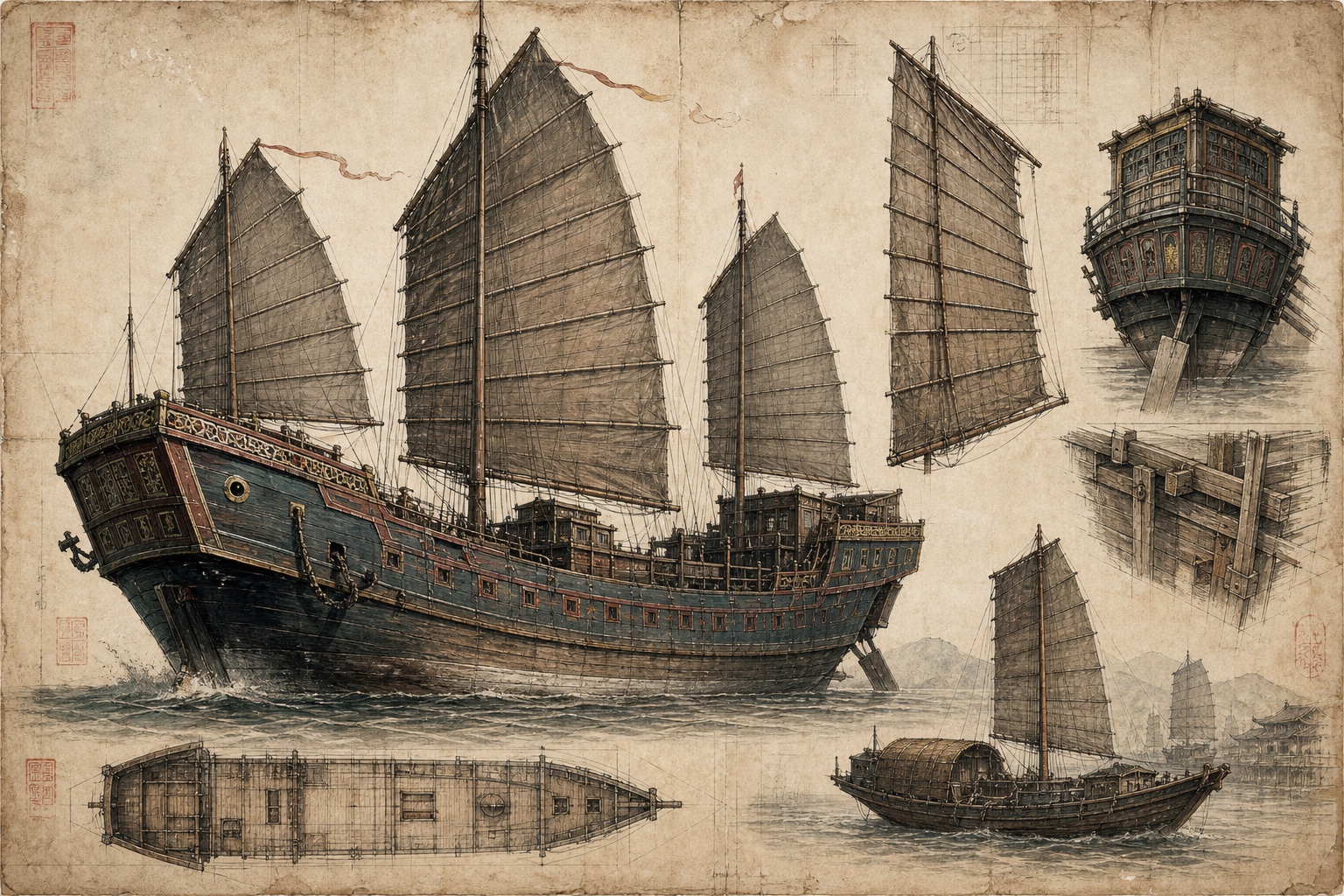
The design current
Not one maritime tradition. A collision of systems.
Hidden Tide follows the water outward from Sacramento. The production’s vessels begin with Chinese shallow-water intelligence, meet the towering rigs of British trade, and absorb the speed language of American schooners and packet ships.
Plate 01
South China Sea · Pearl River Delta
The junk is a system, not a silhouette.
Brine · Her first realm was a ship.
Open Brine’s journal →The Chinese ship is Brine’s original realm. She knows ships because her parents taught her right: by hand, under pressure, with survival in every repair.
Brine · Chinese junk-built craftBattened lug sails · high stern · adjustable rudder · shallow-water logic
Download production plate ↓Plate 02
Britain · Atlantic and East India routes
Height turns canvas into architecture.
Sable Fin · Power is familiar. Control is the mistake.
Open Sable Fin’s journal →The British ship is familiar to Sable Fin. Its order resembles power, and that power is closely linked to—and often mistaken for—control.
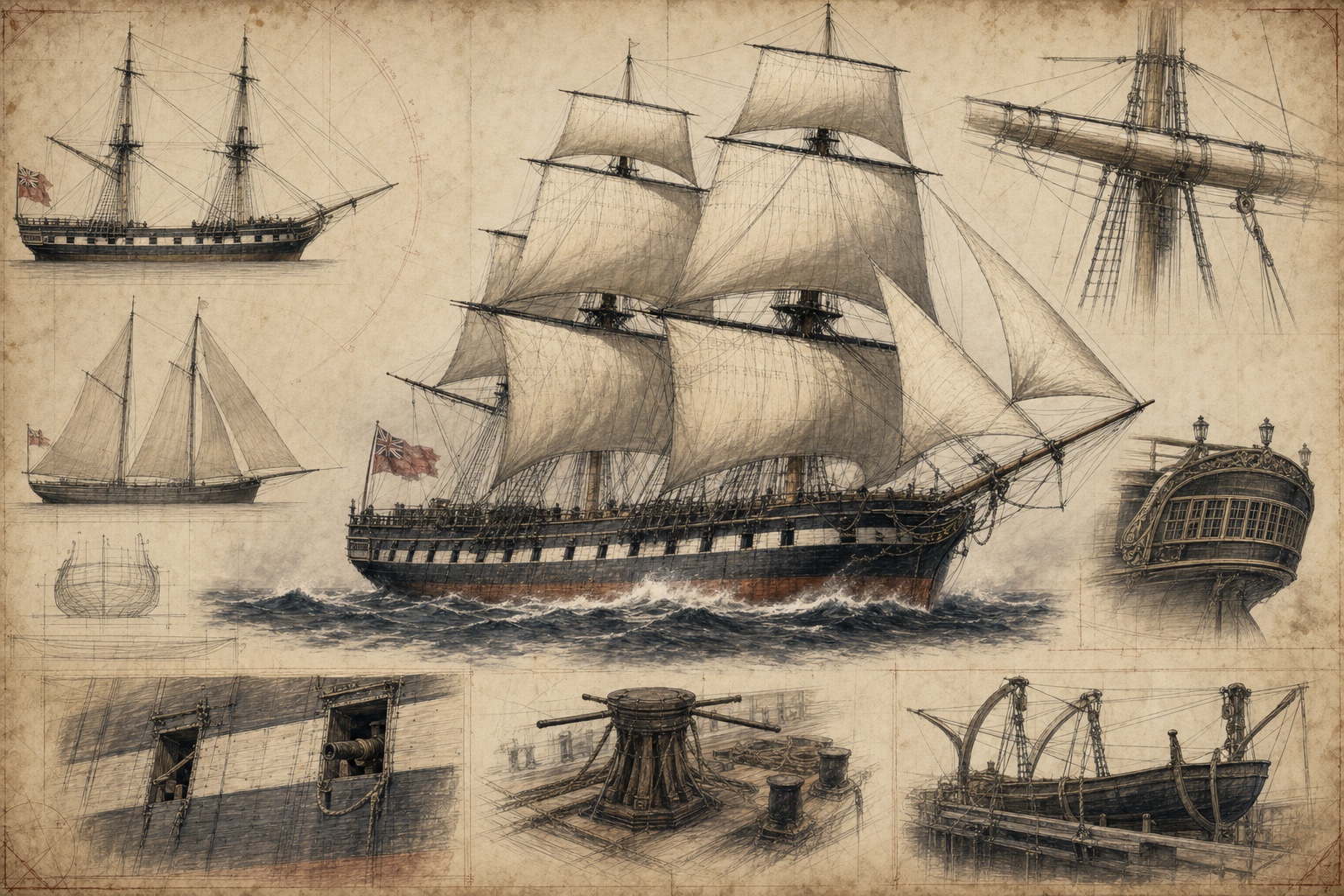
Sable Fin · British square-rigged powerMerchantman · armed brig · square yards · stern galleries · vertical hierarchy
Download production plate ↓Plate 03
United States · Chesapeake and transoceanic trade
Speed changes the moral weather.
Mira Vane · Speed is piracy’s margin.
Open Mira Vane’s journal →Mira Vane is at home on the American ship. She is obsessed with speed because piracy depends on closing distance, breaking pursuit, and choosing the moment of escape.
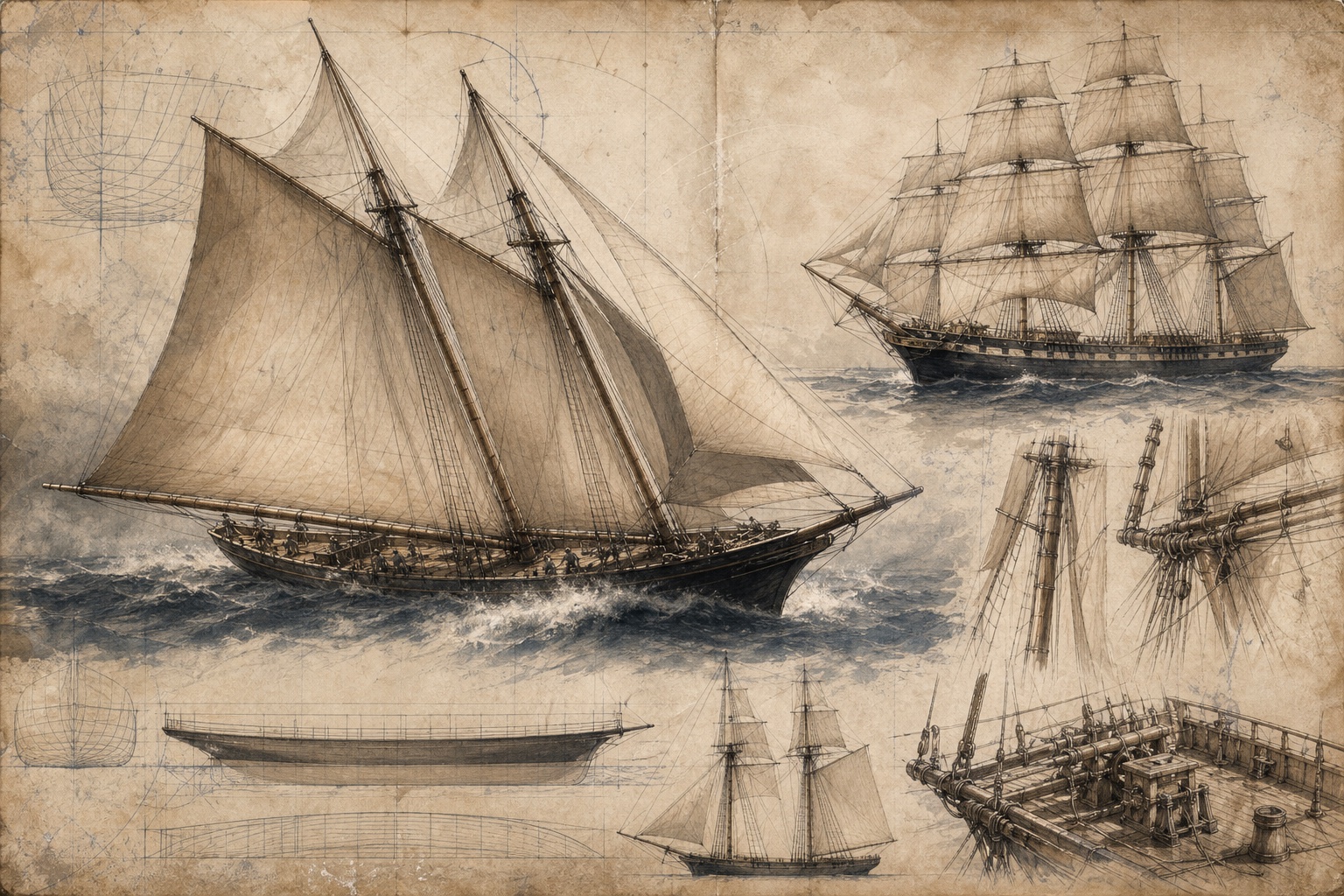
Mira Vane · American speed cultureRaked masts · low hull · fore-and-aft sail · packet routes · transpacific ambition
Download production plate ↓Plate 04
Every ocean · The working rig
Power lives in the reeving.
A nineteenth-century sailor did not call it a pulley. The wooden housing was a block; the wheel inside was a sheave; the rope threaded through a set of blocks made the tackle. Together they turned human rhythm into lifting power.
One fixed block merely changed the direction of a pull. Add a moving block and more supporting parts of line, and the load felt lighter—but the crew paid for every gain by hauling more rope, through more friction.
Anatomy of a ship’s block
The pulley was only one piece of the machine.
A wooden block held one or more grooved wheels called sheaves. Once a line was reeved through two blocks, the working assembly became a tackle or purchase.
- 01 · Shell
- Hardwood cheeks carried the strain.
- 02 · Sheave
- The grooved wheel guided the fall.
- 03 · Pin
- The axle passed through shell and sheave.
- 04 · Strap
- Rope or iron bound the block to its load.
Working demonstration
Rig the purchase. Call the hands.
Choose a sail and period tackle. The deck party changes as force is traded for hauling distance.
TOPDECK
Main topsail
Ready on the halyardMain topsail · Bell purchase3,000 lb illustrative moving load
An equivalent moving load for heavy canvas, yard, and starting strain. At this purchase, the fall carries about 681 lb-force before the crew shares it.
The imagined Hidden Tide vessel
Three design languages. One ship that could only exist in fiction.
The production does not reproduce a single historical vessel. It combines maritime ideas to make geography, conflict, and exchange visible from the back row.
Brine adapts to the water.
Shallow draft, flexible sail control, adjustable steering, repair intelligence, and a hull she understands as inheritance rather than ornament.
Sable Fin makes power vertical.
Tall square rigs, formal stern architecture, gun-deck rhythm, and an order whose resemblance to control is both useful and dangerous.
Mira Vane puts risk in the rake.
Low fast lines, canted masts, working-deck urgency, and an obsession with gaining the distance piracy needs.